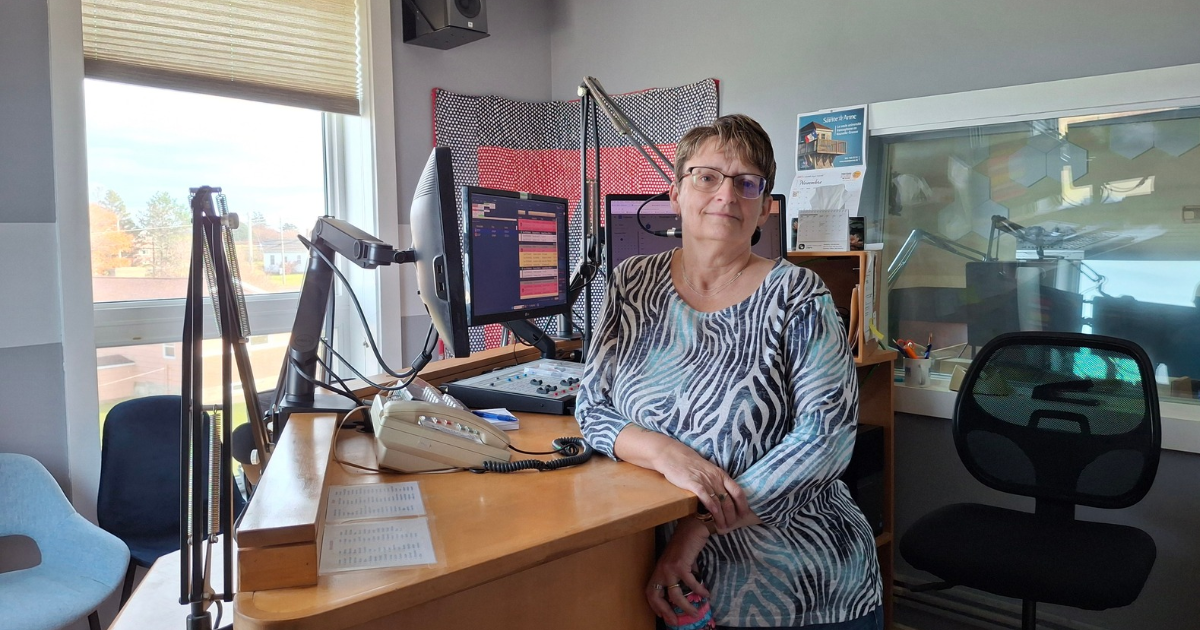
“If there was no bingo, there’d be no radio station.”
That’s Lisa Doucette, the general manager of CIFA, Clare’s French-language community radio station. She means it. Radio bingo is the station’s biggest source of money, bigger than government funding. Without it, she told me, there would be a much smaller station and probably no employees.
I toured the station this week, and I came home thinking about a lot more than bingo.
Why I keep thinking about this
I’m English. I moved to Clare in 2020, and before I moved here I didn’t know Acadians were a thing. I didn’t know Cajuns and Acadians were the same thing. I grew up without much of a culture of my own, and when I look at someone else’s I get a little jealous. It gives people a sense of home. Knowing where you come from makes it easier to know where you’re going.
Lisa told me that in a lot of places now, you can’t walk into a store and be served in Acadian French. The big festivals show the culture off, and that’s wonderful, but the stretch in between is where it gets quiet. “That’s when you have to panic,” was her way of putting it. When I said Acadians should really care about getting involved with the station, she said that’s why they’re panicking. Not enough people are getting involved.
A small community radio station is one of the things that fills that stretch. It’s French on the air all day, songs by artists from the Maritimes, and voices from down the road. Lisa says most of the private radio stations in Nova Scotia are now owned by large companies, and community stations like CIFA are getting hard to find. Clare has one run by its own neighbours, who choose the music, the hosts and the language. I’d call that a sovereign act. A community decided its language stays on the air and then kept it there, one bingo night at a time.
I think a lot of people don’t realize this when they’re just listening. You can join for $5 and vote on where the station goes. You don’t need to be a member to host a show, send in your music or buy an ad. Anyone can. You do need to be a member to vote or sit on the board. It’s a media outlet that belongs to the people it serves, and it needs those people to show up.
You don’t have to be Acadian to care. You live here. You’re surrounded by the music, the food, the language and the humour, and you get to enjoy all of it. Helping it keep going is a small thing to do in return, and later on someone’s grandkid will be able to understand where their family came from and still speak their language.
Fort Knox and the bingo machine
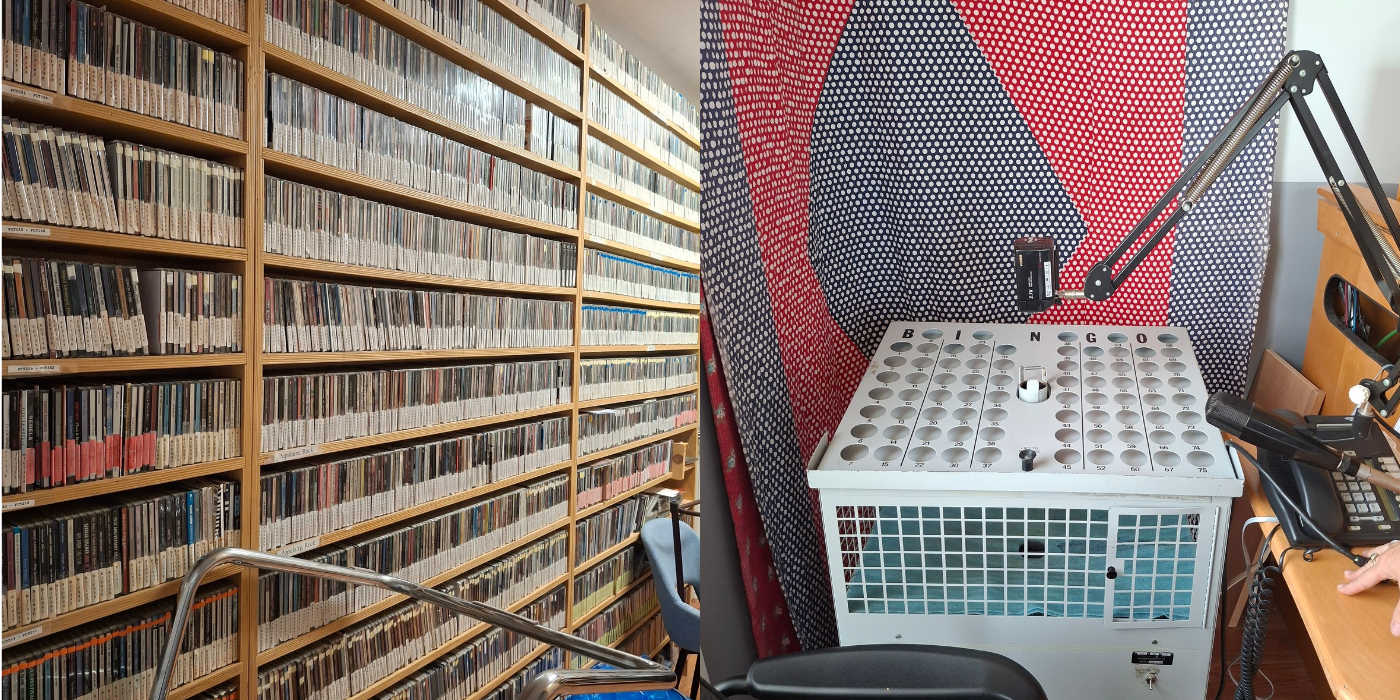
Behind a locked door at CIFA sit all the bingo cards. Lisa calls it Fort Knox. One night the fire door wasn’t closed properly, and when the announcer came in that morning he had two pigeons in the studio waiting for him! They make sure it’s closed properly now, so no wildlife come visit, or ghosts…but that’s another story. Radio has problems I never would have guessed.
From paint expert to station manager
Lisa didn’t start in radio. She was working at Sissiboo Home Hardware in Weymouth, where she was the paint and interior design expert, and she and her friend Susan started making funny radio ads for the store. They played two little old ladies, Bernadette and Agnes, who complained about everything. People loved them.
When a Saturday morning announcer and bingo caller job came up at CIFA, the manager at the time told her to apply. About a year later the manager left, and Lisa thought, maybe I can do this. That was 2018. She’s been at it eight years now, and she runs the budget, the staff, the ads and the programming. She was in the middle of preparing for CIFA’s annual general meeting when I got there.
You can join for $5
For $5, you can become a member of CIFA for life. Members vote at the AGM and get a say in where their radio station goes.
Not many people show up. Lisa wants more of them, and she wants the questions too, even the hard ones. It’s a community radio station, she said, so sometimes those conversations have to happen.
Old songs, new songs, and a fiddle hour
For years CIFA was known for old, old songs. The older listeners loved it. The younger ones didn’t. Lisa figured out the math pretty quickly. She told her mother that one of these days the older listeners will be gone, and then she’ll be stuck with no listeners at all.
So three or four years ago she started changing things. The daytime is French, and it’s now more modern pop, rock, country, whatever is good. After six, the volunteers get more freedom, and that’s where it gets fun. Monday nights, Ronald Bourque plays old English country music and has a loyal crowd. Saturdays have an hour of fiddle music from a volunteer who has shown up every week for over 20 years. Saturday evenings start with the 50s and 60s, followed by the 70s, then the 80s and 90s. Later at night you might get jazz, electropop or heavy metal. It’s working. Lisa says the station’s listeners are getting younger.
I never really understood how a radio schedule works until Anne Blinn showed me. She builds it in a program called WinMedia, and the job is less about what the station wants to play than about how long each song is. The ads are supposed to run about every 15 minutes, so the songs in between have to add up to the exact time. The computer fills in the schedule on its own, but it picks songs at random lengths, so Anne goes in behind it and swaps them around until everything lands where it should. When she needs a song that’s a minute and three seconds, she sorts the song list by length and hunts for one. When a block is a few seconds off, it shows yellow. Too long, it goes blue. Just right, it goes green. “I love seeing the green,” she told me. Lisa once spent a whole show prep watching her song picks vanish, because Anne was fixing the same schedule at the same time and neither of them knew. They found each other eventually.
If you make music, send it in
If you’re a local musician, you can email CIFA an MP3. “If it’s French, it’s pretty much guaranteed we’ll play you,” Lisa said. English music from local artists still gets played, mostly in the evening hours.
There’s also a weekly Top 10 of French music, with a preference for Maritime artists. It goes up on their Facebook page on Monday mornings and plays on the air Wednesday morning, and the artists get told where they landed so they can share it with their own followers.
A 14-year-old with a talk show
Every Wednesday night, a 14-year-old hosts a talk show called An Evening in Clare. He invites people on and they talk about whatever they’re known for. I know him from Comeau’s Farm Market, which made it even better to see him on the screen with a guest. Lisa says he’s getting close to 700 followers.
CIFA is looking for more volunteers who want to host something, especially in the afternoons and evenings. You don’t need broadcasting experience. You need an idea.
The voices on the shelf
CIFA also has old shows that aren’t on the air anymore, and Lisa didn’t want to delete them. She loves history, so she had André put them on social media. He handles the station’s Facebook, Instagram and YouTube. One is a show where Jean Louie Belliveau interviewed older people from the community. Jean Louie has passed away, and so have most of the people he interviewed. Their voices are still there.
The wall of Acadian words
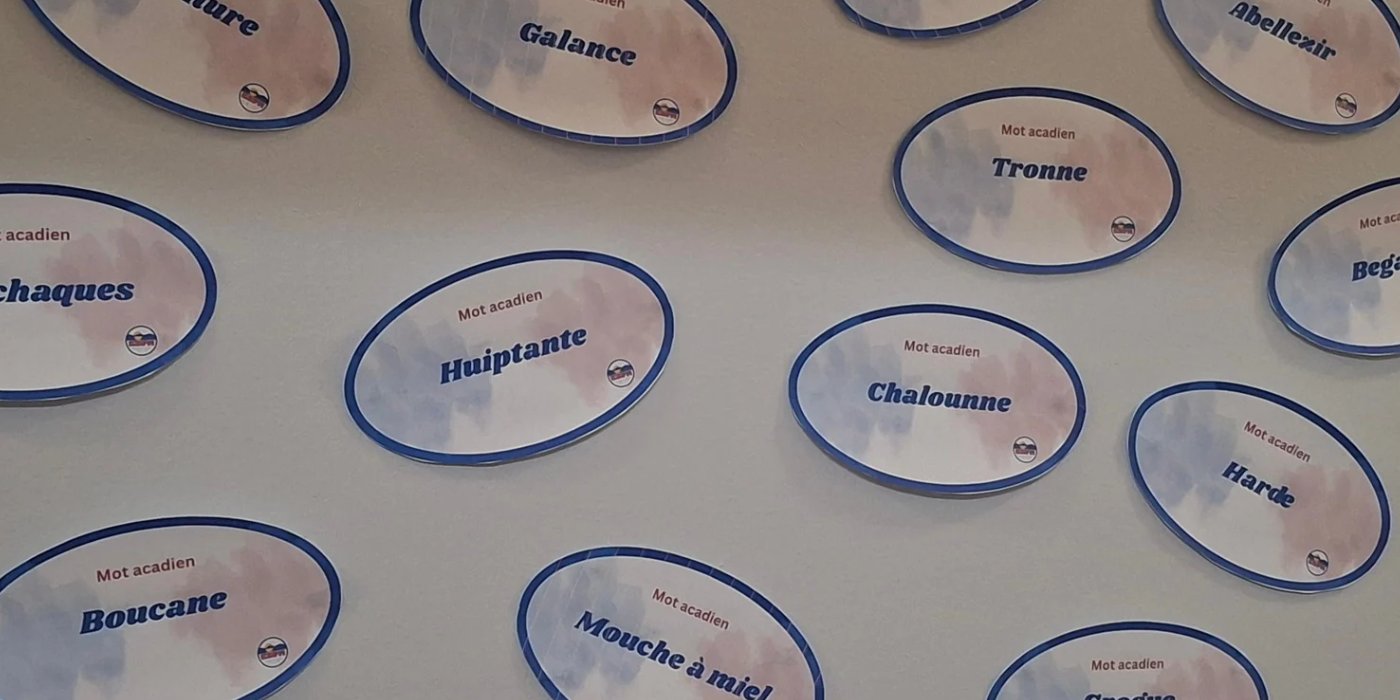
Lisa keeps a wall of Acadian words. Whenever she remembers one or learns a new one, it goes up on the wall. Once a week she quizzes André, who is Acadian and younger, on what they mean. Some he knows. Some he has no clue about, and his guesses are so funny she told me about them twice.
She’s not doing it only for laughs. Those words are getting lost between generations.
Learning Acadian French as an outsider can be easier than you’d think. Lisa told me about her husband Dave, who moved to Clare at 14 or 15 and fell in with a group of local boys. There were a lot of kids in every community back then. The boys told him they’d speak English with him for a week, and after that he’d have to learn. He did. These days he speaks Acadian French like he grew up with it, even though he never learned to read it. The only giveaway is that he sometimes mixes up le and la, and an Acadian would pick that up right away.
How to help CIFA
- Become a member. $5, lifetime, comes with a vote at the AGM. Go in and see them at 795 Highway 1, Comeauville, or call 902-769-2432 (CIFA).
- Go to the AGM and ask your questions. It’s Monday, Nov 9 at 6:30 pm at the Municipal Office, 1185 Highway 1, Petit Ruisseau (Little Brook). The public is welcome.
- Volunteer. They want people to host shows, especially afternoons and evenings, and people for the board. Board members need to be CIFA members and bilingual (French and English), and it’s about 2 to 3 hours a month.
- Send in your music. Email an MP3. French is almost guaranteed airtime.
- Advertise. Businesses can buy a package of ads or small “social” ads, like wishing the fishermen well on dumping day or Christmas messages. It’s a way to support the station when you don’t have anything to sell.
- Write. CIFA has to produce 111 articles by March 31 through the Local Journalism Initiative, and Lisa is looking for another freelancer who writes standard French.
- Follow them on cifafm.com, Facebook, Instagram and YouTube. The old shows are on YouTube.